|
|
|
|
Cash Management Service Program
|
|
ICBC follows the client-centered service philosophy, and tailor-make
comprehensive cash management solutions for the clients by means
of rich cash management products and advanced electronic instruments
in close combination with the clients' internal management systems
after profoundly learning about the clients' operation flow, management
mode and capital flow characteristics to meet the demands of the
clients for individualized cash management.
1. Group Service Program I
● This program can help a group realize real-time collection from
its branches and exert effective control over the payment of the
branches.
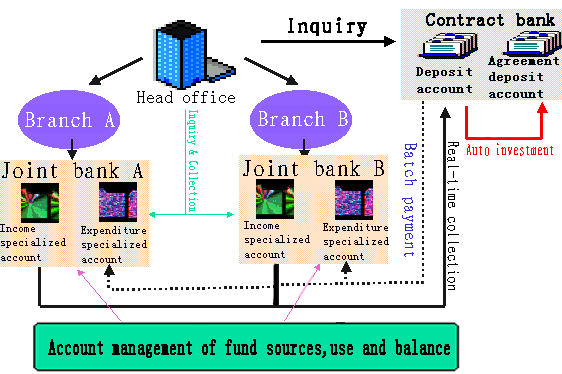
● Basic account structure: the head office sets a settlement account
used for the settlement with its branches and other companies, and
an agreement deposit account used for overnight investment; and
separately establish “income specialized accounts" and "expenditure
accounts" of the branches.
● Collection: the intermediary bank periodically, initiatively
transfers the funds from the "income specialized accounts" to the settlement account of the head office.
● Payment: a client's head office unitedly appropriates the funds
from its settlement account to the "expenditure accounts" of the branches.
● Investment: transfer the funds pooled by the client in excess
of the retain line at the end of a business day into the agreement
deposit account and carry them back fully at the beginning of the
next business day so as to improve the deposit yields. The client
can also make other investments.
● The client's head office can initiatively collect the funds from
the "income specialized accounts" of its branches through
the E-bank at any moment, and exert remote inquiry and control on
the accounts of the branches.
● Account management: help the client supervise the fund use of
the "income specialized accounts" and the fund sources
of the "expenditure accounts." The funds of the "income
specialized accounts" can but be paid to the account designated
by the head office, and the funds of the "expenditure accounts" can but be unitedly appropriated by the head office.
The flow chart is shown as follows:
|
|
|
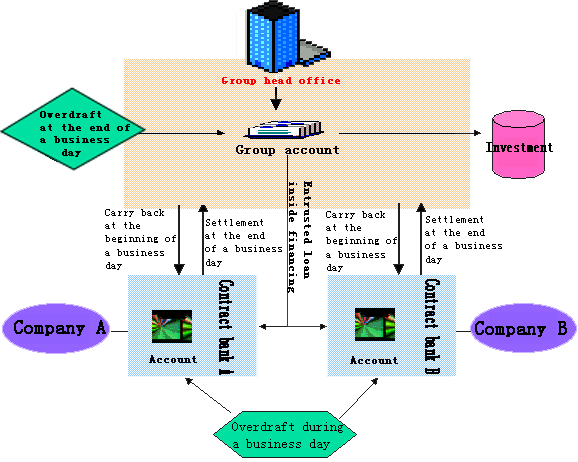
2. Group Service Program II
● This program can help the group unitedly manage its internal funds,
reduce the fund redundancy of the whole group, reduce the cost of
capital and increase the use efficiency of capital.
● Account structure: the group sets a summary account with overdraft
functions; each branch sets zero-balance basic account with overdraft
functions.
● Pool the funds in the accounts of each member unit at the end of
business day into the summary account of the group.
● Carry the funds totally back to the account of each member unit
from the summary account at the beginning of the next business day,
without affecting the normal use of the member unit in the daytime.
● Provide overdraft within the overdraft buffer when the funds of
the summary account fall short at the end of each business day.
● Any surplus of funds in the summary account will be turned into
investment at the end of business day.
● It can provide account overdraft for each member unit within the
buffer in the daytime, and any balance of overdraft at the end of
business day will be settled with the summary account.
● Provide entrusted loan services whereby the head office can balance
the fund surplus and deficiency between its internal member units.
The flow chart is shown as follows:
|
|
|
3. Transnational Service Program
● This program can help the transnational corporations conduct remote
control and operation on the accounts of their domestic companies,
and include the cash management of the domestic companies into the
unified platform.
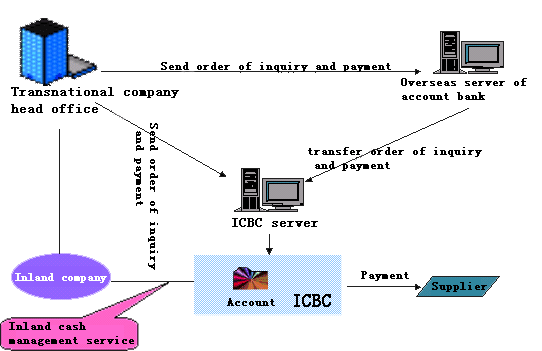
● Program I: The group head office can make remote inquiry/payment
on/from the accounts of its domestic companies through ICBC Internet
banking.
● Program II: The group head office can submit the inquiry/payment
instructions through its foreign account bank to ICBC, and thus realize
the remote inquiry/ payment on/from the accounts of its domestic branches.
● At the same time, it provides high-quality cash management services
for the domestic companies of the transnational corporation.
The flow chart is shown as follows: |
|
|
|
4. Bank-enterprise Interlink Solution
Through private lines or Internet, ICBC e-Fortune Link Corporate Internet Banking
establishes bank-enterprise interlinks with the clients' financial
systems or ERP systems by which the clients can enjoy account inquiry,
information download, account transfer/payment and other services
directly through the interfaces of the financial systems or ERP
systems, tailor-make more individualized functions in their financial
systems at their discretions as required, and realize high automation
of cash management. The characteristics of this program are:
● Bank-enterprise synchronous account information. The bank-enterprise
link organically connects the enterprises' financial systems with
the bank's business processing system, integrates the system resources
of both parties, and provides real-time, accurate, all-round financial
information support for the financial decision-making of the enterprises.
● Individualized services. Any enterprise can conduct free combination
and control over the "atomic" functions provided by the
bank through the financial software system as its own financial
management requires, flexibly tailor-make internal authorization
mechanisms, and thus owns its own proprietary bank.
● Simple operations and high efficiency. The financial personnel
of the enterprise do not need to repeatedly type in any instruction
data, but input all instructions in one go, and can finish the external
payment and update financial system and financial information immediately
after getting examined and authorized, simplify the procedures and
facilitating the clients' use.
● Safety and reassurance. Besides adopting the same safety mechanism
with Internet banking, it also add "Wrapper serial ID"
field in all transactions, and "signature time" field
in account transfer transactions so as to effectively prevent the
risks of hacker attacks, repeated instruction submission etc.
|
 |
|